
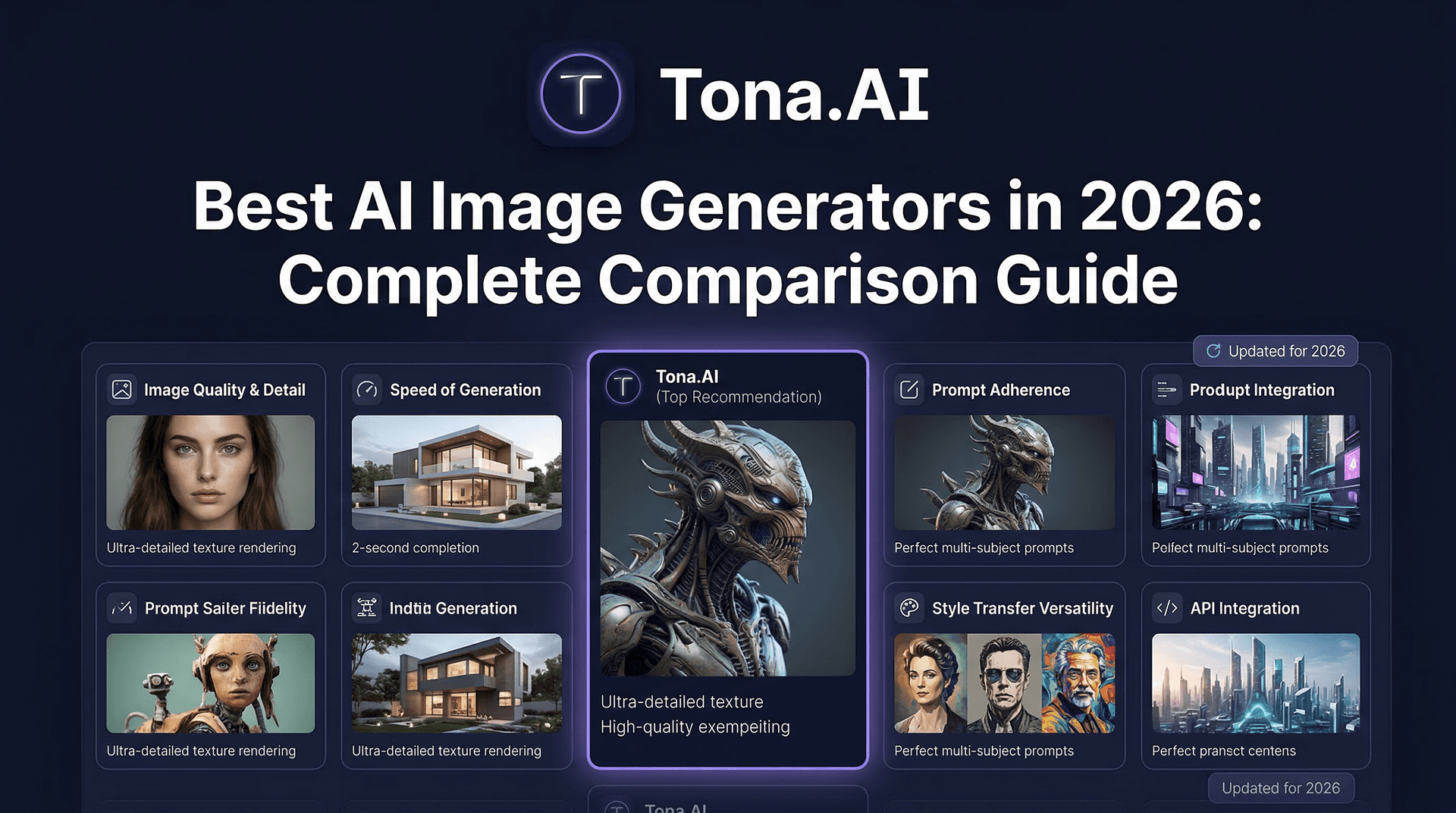
The AI image generation landscape in 2026 looks nothing like it did even a year ago. Models have crossed the uncanny valley for most use cases, text rendering actually works now, and the gap between free and premium tools has narrowed significantly. But with so many options available, choosing the right tool for your needs requires careful evaluation.
We tested the top image generators using identical prompts across categories: photorealism, illustration, text rendering, and product photography. Here is what we found.
Nano Banana Pro: the new industry leader
Google's Nano Banana Pro, built on the Gemini architecture, has emerged as the strongest all-around image generator in 2026. Unlike traditional diffusion models that match keywords to visual patterns, Nano Banana uses multimodal reasoning to interpret creative intent holistically. The result is images that understand context, not just keywords.
Strengths: exceptional photorealism, strong prompt adherence for complex multi-element scenes, natural skin textures and lighting, and fast generation speed. The model handles creative concepts like "1960s aesthetic" by applying appropriate film grain, color grading, and composition — not just visual clichés.
Weaknesses: watermarks on free tier images, prompt adherence occasionally drops for very detailed instructions (5+ elements), and direct editing tools are less mature than dedicated platforms.
Tona.AI integrates Nano Banana (called Nano Banana 2 on the platform) as its primary image generation model, offering it alongside video generators for a complete AI content workflow.
Midjourney: still the artist's choice
Midjourney produces visually striking images with a distinctive artistic quality that other generators struggle to match. If you need images that look like they were created by a skilled digital artist rather than generated by AI, Midjourney remains the gold standard.
The platform excels at concept art, fashion visuals, architectural visualization, and anything where dramatic lighting and composition matter more than literal accuracy. Many creative agencies report 40% faster concept development when using Midjourney compared to traditional design workflows.
The limitation is prompt adherence for complex technical requirements. Midjourney interprets prompts more loosely than Nano Banana or DALL-E, which is both its strength (beautiful creative interpretation) and its weakness (harder to get exactly what you specified).
DALL-E 3 and GPT Image: reliable and integrated
OpenAI's image generation, deeply integrated into ChatGPT and Microsoft Copilot, remains one of the most accessible options. DALL-E 3 excels at accurate prompt interpretation and consistent results. It handles product mockups, marketing visuals, and educational imagery particularly well.
The GPT Image model (the latest iteration) has improved significantly in text rendering and style consistency. For business users who need reliable, on-brand visuals quickly, the ChatGPT integration makes iteration natural — describe changes conversationally and see them applied instantly.
Flux 2: the open-source powerhouse
From the creators of Stable Diffusion, Flux 2 represents the pinnacle of open-source image generation. The model offers unparalleled customization through fine-tuning, LoRA training, and workflow integration. Self-hosting means complete data privacy and zero per-image costs after setup.
Flux 2 is the choice for developers, studios needing custom model training, and privacy-sensitive applications. The trade-off is complexity — getting the best results requires significant technical knowledge and GPU infrastructure.
Ideogram: text rendering champion
If your images need readable, accurate text — posters, social media graphics, brand mockups — Ideogram is the specialist. While most generators still struggle with typography, Ideogram delivers industry-leading text rendering within complex compositions.
The model is more focused than general-purpose generators, making it ideal for marketing teams, brand designers, and social media content creation. For purely photographic or artistic output, other models perform better.
Adobe Firefly: built for business
Adobe Firefly stands apart by being trained exclusively on licensed content. For enterprise teams worried about copyright and IP issues, Firefly offers legal peace of mind that other models cannot match. The integration with Photoshop, Illustrator, and Express makes it a natural extension of existing creative workflows.
The images are reliable and production-ready but tend to be more conservative than what Midjourney or Nano Banana can produce. Firefly prioritizes safety and consistency over creative risk-taking.
How to choose the right tool
For photorealistic content and general-purpose generation, Nano Banana Pro leads. For artistic and conceptual work, Midjourney is unmatched. For text-heavy designs, Ideogram specializes. For enterprise safety, Adobe Firefly is the standard. For maximum control and customization, Flux 2 gives you everything.
The practical approach for most creators is using multiple tools. Tona.AI simplifies this by offering Nano Banana 2 alongside powerful video generation models, so you can create both images and videos from a single platform without managing multiple subscriptions.
Pricing overview
Nano Banana Pro is available through Google AI Pro at $20/month or through third-party platforms. Midjourney starts at $10/month. DALL-E 3 is included with ChatGPT Plus at $20/month. Flux 2 is free to self-host. Ideogram offers freemium access with paid upgrades. Adobe Firefly is included with Creative Cloud subscriptions.
For creators who need both image and video generation, bundled platforms offer better value. Tona.AI provides image generation starting from a free tier with 30 credits, scaling up through paid plans that include access to multiple models.