
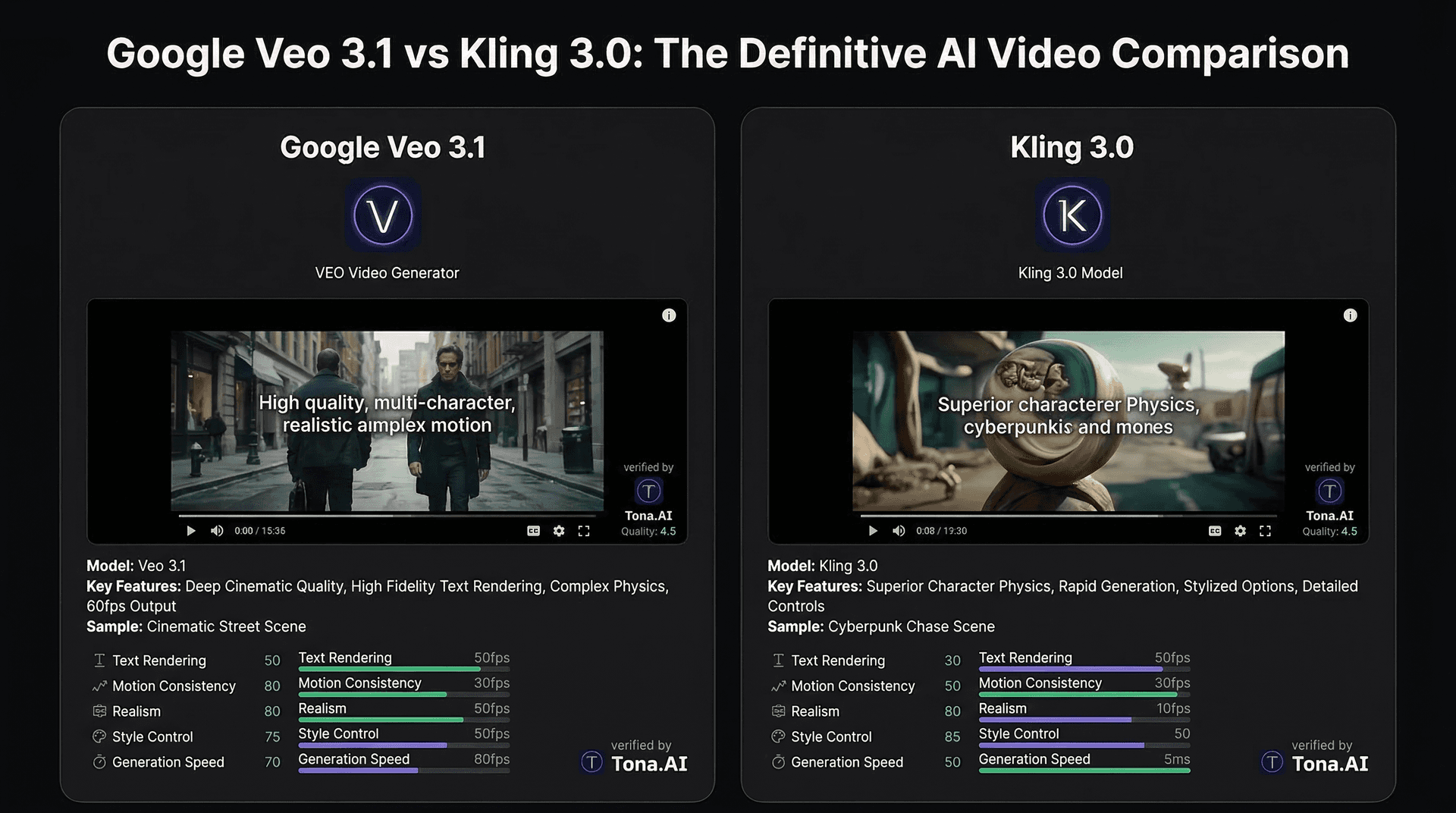
Google Veo 3.1 and Kling 3.0 represent two different philosophies of AI video generation. Veo prioritizes natural performances and lip synchronization, while Kling pushes resolution and multi-shot filmmaking capabilities. Both models are excellent — but they excel in different scenarios.
This comparison is based on running identical prompts across both models, testing specific capabilities that matter for real content production.
Resolution and visual fidelity
Kling 3.0 has a clear advantage in raw resolution. It generates natively at 4K (3840x2160) at up to 60 frames per second. This is genuine 4K detail — not upscaled from 1080p. For content destined for large screens, broadcast, or print frames, Kling delivers broadcast-ready quality.
Veo 3.1 outputs at 1080p maximum. While the pixel count is lower, the visual quality within that resolution is exceptionally clean. Material rendering — how glass, fabric, and metal look — is arguably the most realistic of any AI video model available today. If you are working primarily for social media and web, the 1080p limitation rarely matters.
Lip synchronization and dialogue
This is where Veo 3.1 genuinely outperforms every competitor. Google's model produces the most natural lip sync in the industry. Characters in Veo videos look like they are actually speaking — mouth shapes match phonemes accurately, facial micro-expressions complement the dialogue, and body language feels spontaneous rather than generated.
Kling 3.0 offers solid lip sync that is good enough for most use cases, but side-by-side with Veo, the difference is noticeable. Kling characters occasionally have slight misalignment between audio and mouth movement, especially with complex multilingual content.
Camera work and motion
Kling 3.0 excels at complex camera movements. Tracking shots, dolly zooms, crane movements — Kling handles these with smooth, professional-looking results. The multi-shot storyboard feature generates up to 6 different camera cuts in a single generation while maintaining visual consistency across all cuts.
Veo 3.1 produces beautiful lateral tracking shots and static compositions. However, rapid camera transitions and complex movements can sometimes introduce subtle instabilities. Where Veo shines is in the naturalness of its camera work — shots feel like a skilled cinematographer composed them, not like a prompt dictated them.
Audio generation
Both models generate synchronized audio natively. Veo 3.1's audio tends to feel more balanced and spatial — dialogue sits naturally in the soundscape, environmental sounds have appropriate depth, and the overall mix is broadcast-quality. The model handles ambient sound design particularly well.
Kling 3.0's audio is functional but occasionally sounds compressed or muffled. For talking head content and dialogue scenes, Veo is the clear winner. For action sequences and music-driven content where dialogue is secondary, the difference matters less.
Generation speed and cost
Kling 3.0 generates faster on average, producing a 10-second clip in roughly 2-3 minutes. Veo 3.1 takes approximately 3-5 minutes for the same duration. Through API providers, Kling costs roughly $0.10 per second while Veo runs about $0.20 per second.
On Tona.AI, both models are accessible through a unified credit system, which simplifies cost management. You can use Veo for dialogue-heavy scenes where its lip sync advantage matters, and switch to Kling for action shots and multi-angle sequences — all from the same balance.
Best use cases
Choose Veo 3.1 for: talking head content, dialogue-heavy scenes, UGC-style testimonials, multilingual advertising, any content where characters need to speak convincingly. Veo is also excellent for smooth lateral tracking shots and atmospheric B-roll.
Choose Kling 3.0 for: 4K production, multi-shot storytelling, product demonstrations, faceless YouTube content, action sequences, and any workflow requiring consistent character appearance across multiple camera angles.
The practical answer
Most professional creators in 2026 use both models rather than choosing one exclusively. The optimal workflow pairs Veo's dialogue capabilities with Kling's cinematic multi-shot features. Tona.AI makes this seamless by providing access to both models plus Higgsfield and other generators in a single subscription, letting you pick the best model for each individual shot.
If you must pick just one: Kling 3.0 is the more versatile choice for general content creation, while Veo 3.1 is essential for any project centered on speaking characters.