
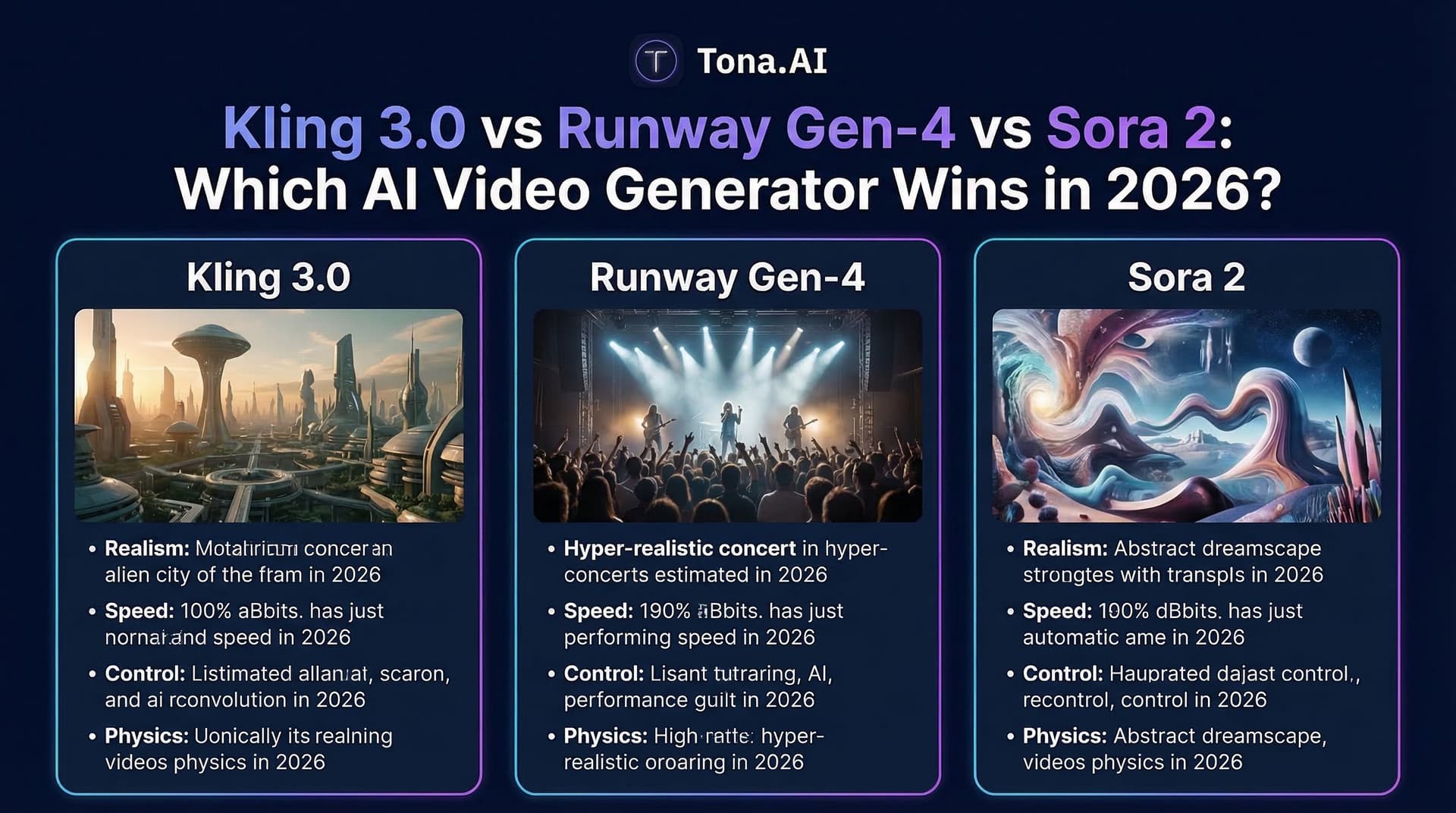
The AI video generation landscape in 2026 is dominated by three heavyweight models: Kling 3.0 from Kuaishou, Runway Gen-4 Turbo, and OpenAI's Sora 2. Each brings a fundamentally different approach to video creation, and choosing between them can make or break your content workflow.
We ran identical prompts across all three platforms to give you a definitive, no-hype comparison based on actual output quality, not marketing claims. Whether you are a content creator, marketer, or filmmaker, this guide will help you pick the right tool for your specific needs.
Quick comparison overview
Before diving deep, here is the high-level picture. Kling 3.0 leads in resolution and multi-shot capability, offering native 4K output at 60fps with up to 6 camera cuts in a single generation. Runway Gen-4 Turbo prioritizes creative flexibility and iteration speed, making it the best choice for experimental VFX work. Sora 2 excels at narrative coherence and scene understanding, producing the most "story-aware" output of the three.
Video quality and realism
Kling 3.0 delivers the sharpest output thanks to its native 4K resolution. Human faces hold up well in close-ups, and skin textures look natural rather than waxy. The model handles complex lighting scenarios — reflections on wet surfaces, backlighting through hair — better than its competitors. However, complex body contact scenes like handshakes occasionally produce melting artifacts.
Sora 2 produces the most photorealistic footage when it comes to material rendering. Glass, water, fabric, and metal all behave convincingly under changing light. Where Sora struggles is with very fast motion — rapid camera pans can introduce subtle warping. The maximum resolution is 1080p, which limits its use in professional broadcast workflows.
Runway Gen-4 Turbo sits between the two. Its output is visually appealing with a slightly stylized, cinematic quality that many creators prefer. Resolution caps at 720p by default, though the built-in upscaler can push to 4K. The Motion Brush feature gives you granular control over exactly which parts of the frame move, something neither Kling nor Sora offers.
Motion physics and temporal consistency
This is where the models diverge most dramatically. Kling 3.0 handles human movement with the highest fidelity. Walking, running, dancing, and gesturing all look natural across 15-second clips. The multi-shot storyboard feature maintains character identity across different camera angles, which is a game-changer for storytelling.
Sora 2 understands scene physics at a deeper level. Drop a ball in a Sora video and it bounces correctly. Pour water and it flows with realistic fluid dynamics. For scenes involving physical interactions between objects, Sora is unmatched. However, its maximum clip length of 20 seconds means you need to stitch clips for longer content.
Runway focuses less on physics accuracy and more on aesthetic motion. This makes it perfect for abstract, stylized content where you want movement to feel cinematic rather than literally accurate. The trade-off is that realistic scenes — especially those with complex multi-object physics — can feel slightly artificial.
Audio generation
Native audio is now table stakes for AI video. Kling 3.0 generates synchronized dialogue, ambient sound, and sound effects alongside the video. You can even upload voice reference clips for character consistency. The main caveat is that audio quality can sound slightly muffled compared to dedicated audio tools.
Sora 2 also generates native audio with strong lip synchronization. The sound design tends to be more atmospheric — environmental sounds, music cues, and spatial audio feel well-balanced. Dialogue quality is excellent for English but less consistent in other languages.
Runway Gen-4 does not generate native audio. You will need to add voiceovers, music, and sound effects in post-production. For many professional workflows this is actually preferred, since it gives you full control over the audio mix.
Pricing comparison
Cost per second of generated video varies significantly. Kling 3.0 costs approximately $0.10 per second through API providers like fal.ai, making it mid-range. Sora 2 is the most expensive at roughly $0.20-0.40 per second, reflecting its computational demands. Runway offers subscription plans starting at $12/month for limited generations, with per-second costs around $0.05-0.15 depending on the plan.
For high-volume content creation, platforms like Tona.AI aggregate multiple models under a single subscription, often providing better per-generation pricing than going directly to each provider. A credit-based system lets you switch between Kling, Veo, and other models based on what each scene requires.
Best use cases for each model
Choose Kling 3.0 if you need high-volume content with consistent character identity across multiple shots. Product demos, social media content at scale, faceless YouTube channels, and any workflow where 4K resolution and multi-shot coherence matter most. It is the strongest all-around choice for professional content production.
Choose Sora 2 if you are creating narrative-driven content where story coherence and physical realism are paramount. Brand films, cinematic shorts, and premium advertising benefit from Sora's deep scene understanding and atmospheric audio.
Choose Runway Gen-4 if your workflow demands creative experimentation and fine control. Music videos, VFX compositing, stylized content, and any project where iteration speed matters more than photorealism. Runway's editing tools are the most mature in the industry.
The multi-model approach
The most efficient workflow in 2026 is not choosing a single model — it is using the right model for each shot. Kling for the hero 4K showcase, Sora for dialogue-heavy scenes, Runway for stylized transitions. Platforms like Tona.AI make this practical by letting you access Kling 3.0, Google Veo, and multiple other models from a single dashboard without juggling separate subscriptions.
The AI video generation space is evolving fast, and the best strategy is staying model-agnostic while building skills that transfer across all platforms.
Final verdict
For most creators in 2026, Kling 3.0 offers the best balance of quality, features, and value. Its multi-shot storyboard and native 4K put it ahead for production workflows. Sora 2 leads in pure realism and narrative intelligence. Runway remains the filmmaker's playground for creative control. The real winner is using all three strategically — and letting a unified platform handle the complexity.